TMDVISUAL - EXCELLENCE IN TMD & BRUXISM.
A full collection of 200 VISUAL PAGES to organize your clinical reasoning, from joint and muscle anatomy to assessment, bruxism, oral appliances and referral.

- Visual pages made to be read at a glance
- Anatomy, assessment flows and recording pages
- A list of sources at the end of every manual
- PDF to read on screen or print
Open a page before the next patient: each one turns a symptom into a question and a next step
Every page was designed to be understood visually: anatomy, assessment flows, comparison tables and recording pages that show the reasoning, not just the conclusion. Cases are simulated.

From anatomy to clinical questions

A consultation that leads to a clear next step
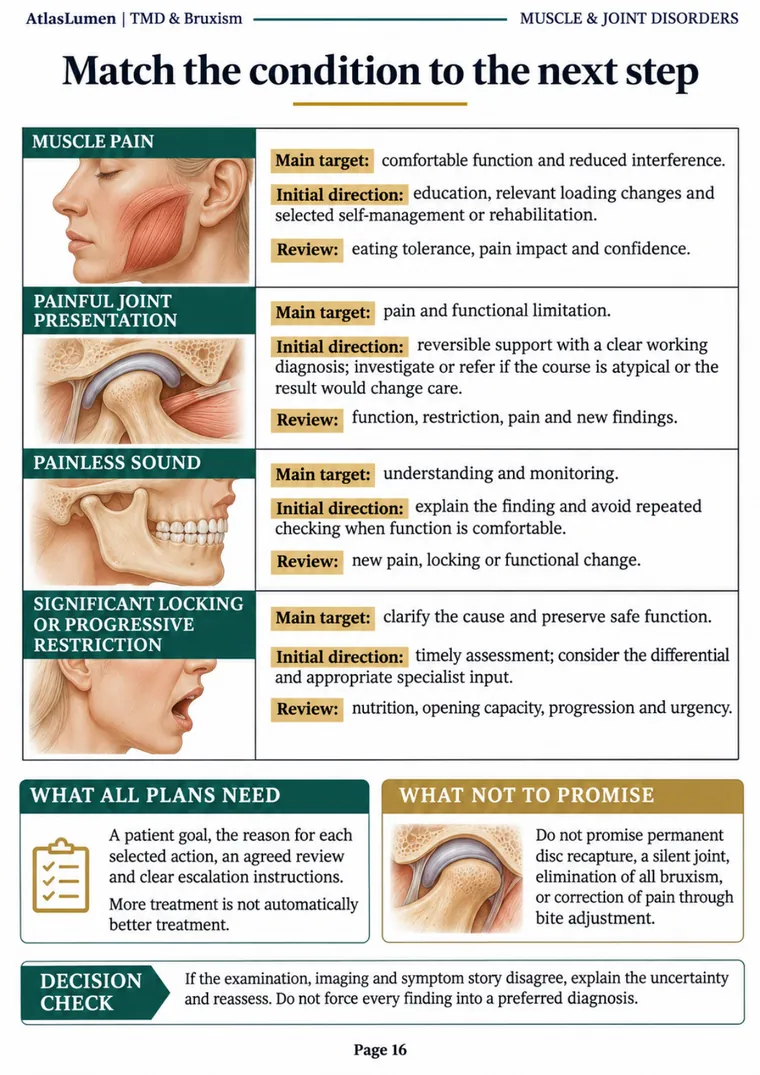
Match the condition to the next step

Clinical signs: useful, but not proof

Choose the purpose before the appliance

Explain the condition and agree on care
The Essential plan includes 6 manuals, from joint anatomy to oral appliances and follow-up.
Each manual is dedicated to one block of the work: assessment, muscle and joint disorders, bruxism, conservative care. Pages with anatomy, flows, tables and checklists, to review a case or to study.
Functional Anatomy and Pain Foundations
Bony landmarks, capsule and ligaments, muscles, movement paths and how pain is processed, framed as questions to ask in the chair.
Clinical Assessment and Diagnostic Reasoning
A five-stage consultation, medical history, a consistent way to measure opening, and a differential you rank and test.
Muscle and Joint Disorders
Myalgia, arthralgia, mixed presentations, systemic conditions that change the pathway, and matching each condition to a next step.
Awake and Sleep Bruxism
Bruxism as behavior and impact: signs that are useful but not proof, restorations, when a sleep referral matters and realistic aims.
Conservative Care and Clinical Follow-Up
Plans the patient can use: explaining the condition, comfort measures, referral to physiotherapy, evidence within its scope and the review.
Oral Appliances: Selection, Use and Review
Purpose first, dental readiness, contacts and movement, wear, fracture and loss of fit, then continue, modify or stop.
MATERIAL DESIGNED TO BE READ AT A GLANCE.
Anatomical illustrations, decision flows, comparison tables and quick records. The layout itself shows the reasoning: presentation, findings, working explanation, next step, review.

Protrusion, excursions and movement paths
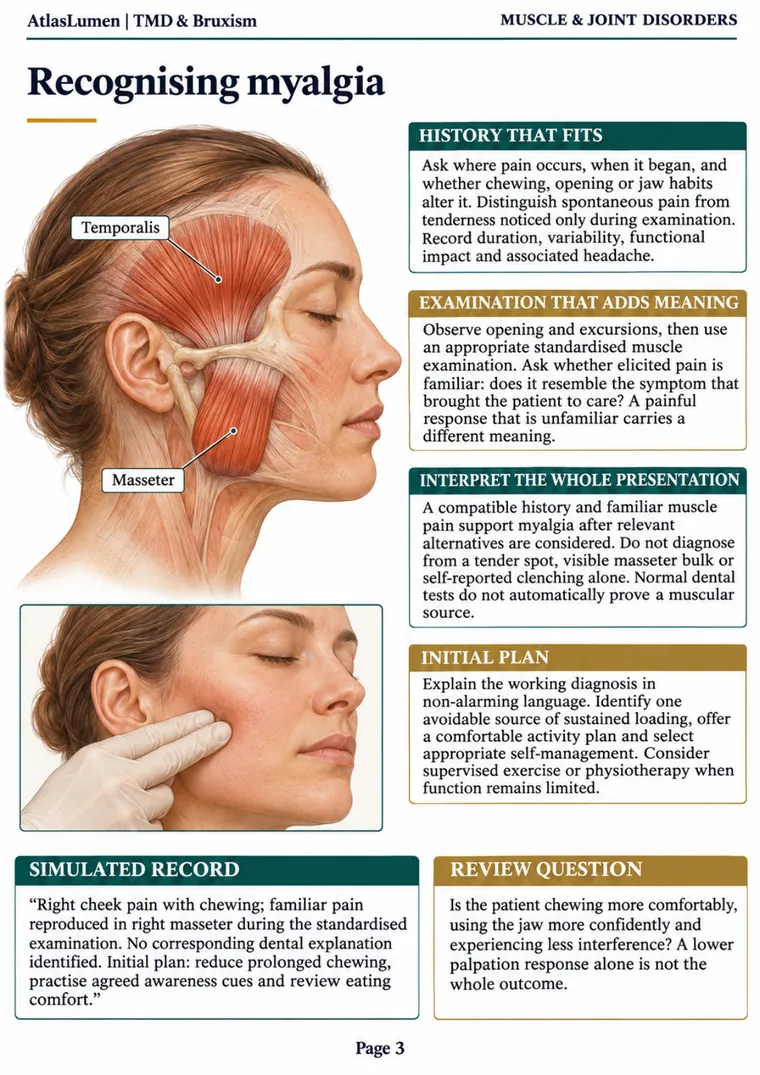
Recognising myalgia
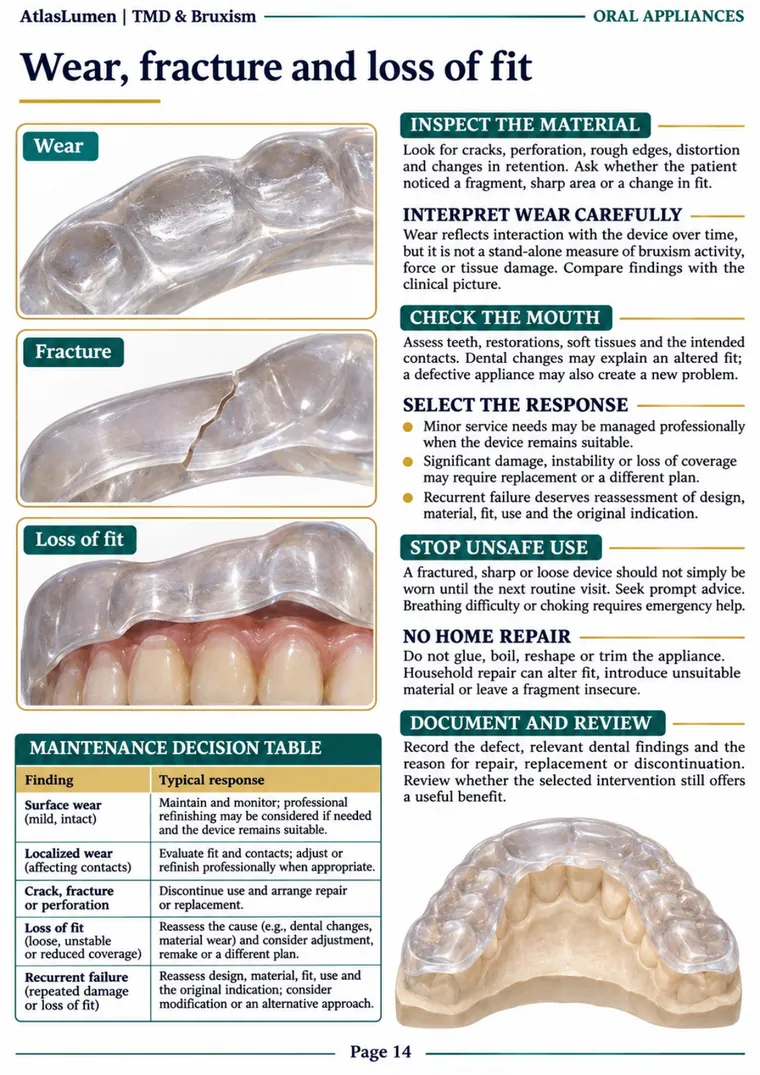
Wear, fracture and loss of fit
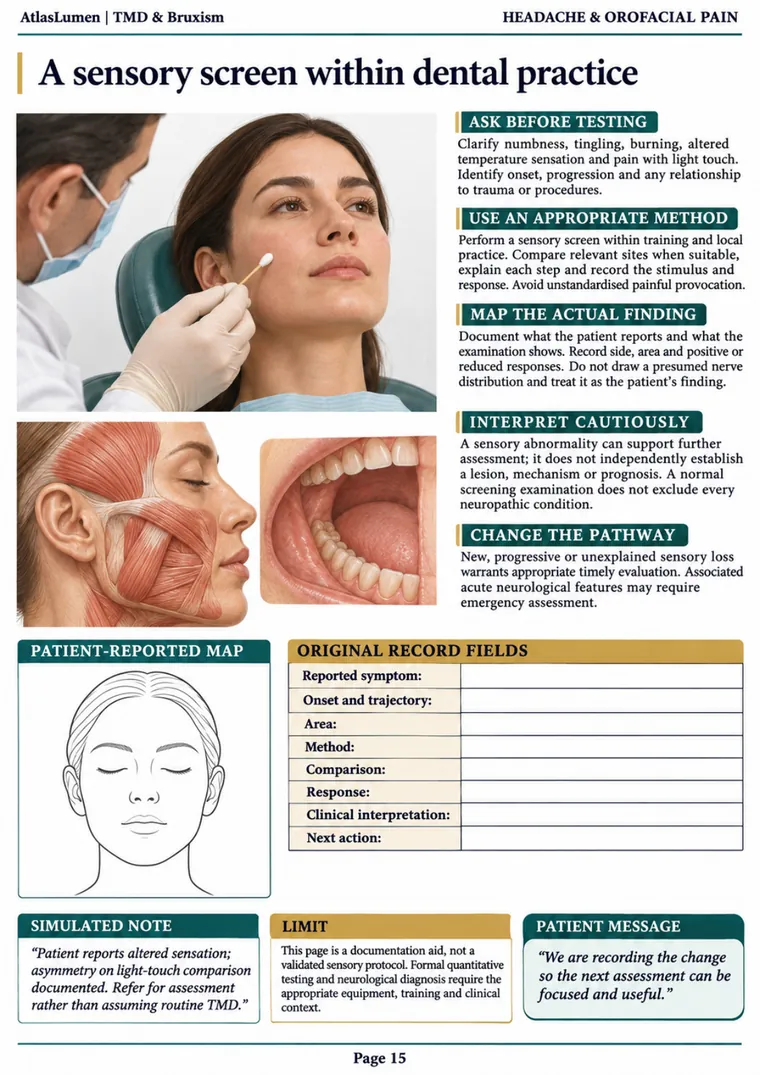
Premium · A sensory screen within dental practice

Premium · A handover the next clinician can use
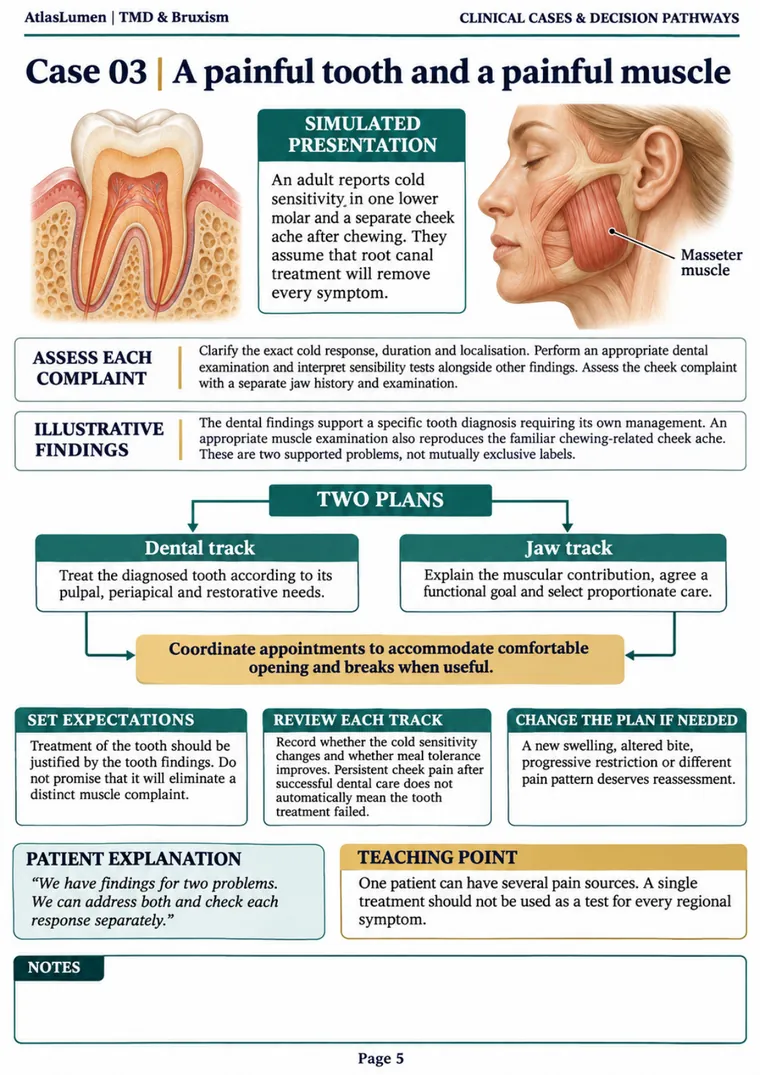
Premium · Case 03: a painful tooth and a painful muscle (simulated)
Made for those who take TMD and bruxism seriously
A visual resource to support study and clinical practice, without replacing the scientific literature, validated examination protocols, clinical supervision or professional judgment.
- Dentists who need a quick-reference guideTo organize the assessment of jaw pain, wear and appliance requests, and to decide the next step with more clarity.
- Recent graduatesA clear structure for the first consultation, with the questions to ask and what to record.
- Dental studentsTo review anatomy, TMD and bruxism with images, not only text.
- Dentists who deliver or review oral appliancesTo check purpose, readiness, fit and review.
- Dental team members and teaching staffTo explain plans, records and referrals in plain language.
Less labeling. More clinical reasoning.
You will not just memorize which pain belongs to which disorder. You will see how to tell a tooth problem from a muscle presentation, a joint presentation, a headache pattern or a nerve-related pain, and which findings change the pathway: urgent assessment, referral or review. That reasoning helps you explain the next step to the patient, with the uncertainty on the table.
I want to secure my access

Every page exists because a difficult concept deserves its own space
The goal was never to pile up pages. It was to build a library in which each manual solves a specific block of reasoning about TMD and bruxism.
Each topic was designed with the format it needs, not one template for everything
Anatomical drawings, step-by-step plans, comparison tables and recording pages. Boxes such as TAKEAWAY, REASONING CHECK and SCOPE highlight what matters most.
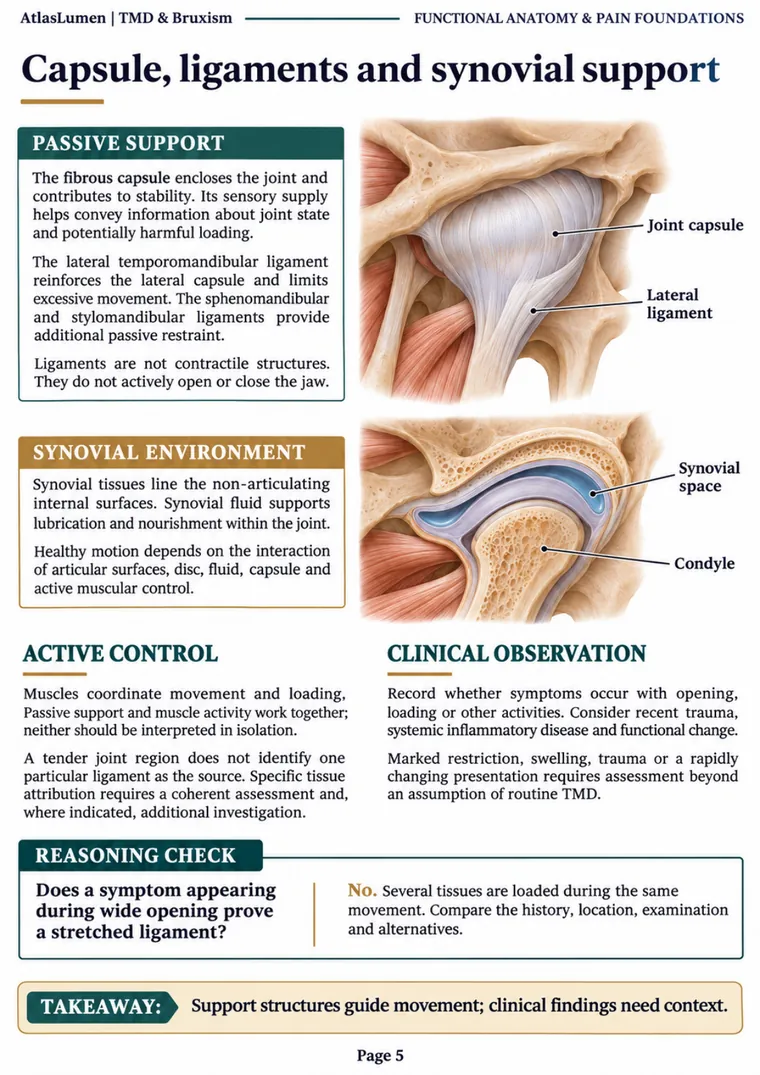
Anatomical illustrations
Joint capsule, ligaments, muscles and landmarks, drawn for the question you are asking.
Start from the anatomy.

Step-by-step plans
From the main problem to the review, with a simulated plan to follow the logic.
Reasoning, laid out.

Comparison tables
Review matrices that put goal, finding and decision side by side.
Compare before you decide.

Recording pages
Printable history, problem list, care plan and review pages.
Document the next step.
From payment to your first page in minutes
100% digital material: access is released instantly, so you can start today.
Choose your option
Select Essential or Premium and pay securely.
Get your access
After confirmation, the material is sent by email.
Download the files
PDFs ready to save on your device.
Read anywhere
Open it on your phone, tablet or computer, even between one patient and the next.
Consult whenever you want
Go back to a page whenever you need it, in the clinic or at school.
Where the pages come into use
Situations where a visual page puts the decision in order.
A jaw-pain consultation
Open the assessment pages and follow the five stages.
A night guard request
Check the purpose before the appliance.
Worn teeth or a fractured restoration
Review what the signs do and do not prove.
A tooth pain that does not add up
Build the differential before treating the tooth.
PremiumA referral letter
State the question, the formulation and the patient's goal.
PremiumExplaining the plan
Use the patient-discussion pages and ask for teach-back.
PremiumIn the PREMIUM VERSION, you get 4 more manuals plus 2 bonuses
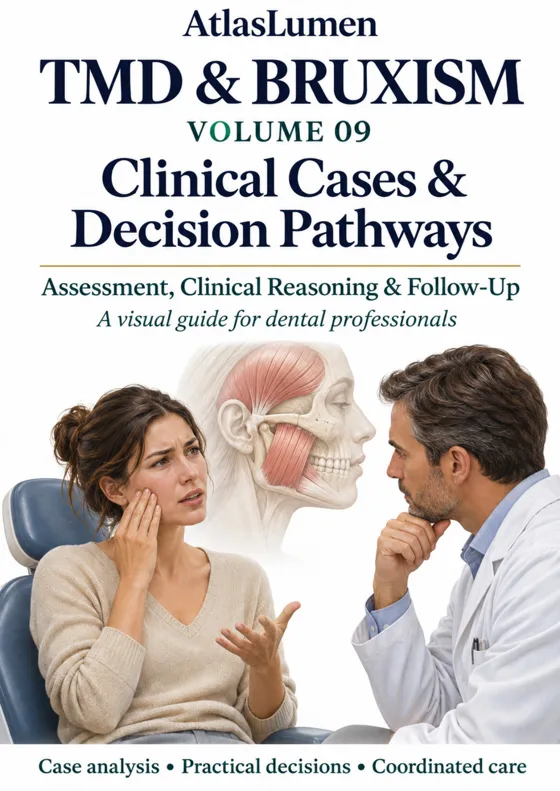
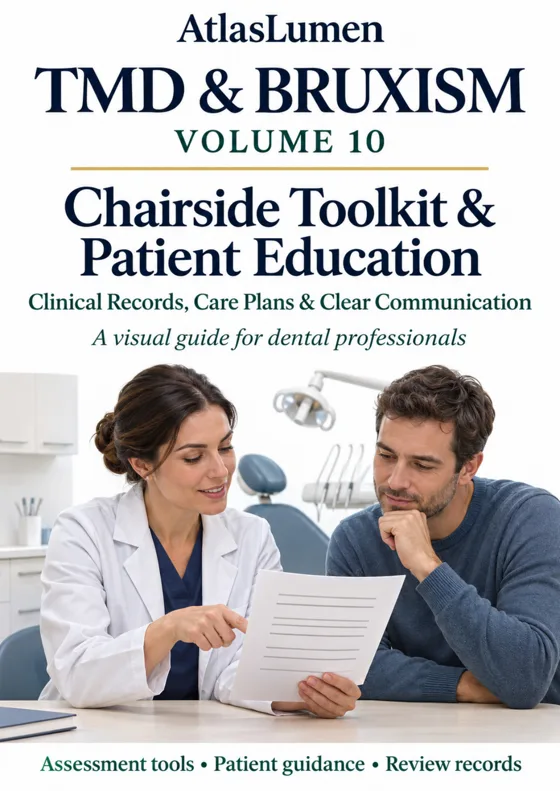
For an additional US$ 2.00 only, you get 4 more manuals, with 80 additional pages on headache and orofacial pain, persistent pain and sleep, clinical cases and the chairside toolkit, plus 2 bonuses.


Essential or Premium. One sequence. One goal: clear, organized clinical reasoning.
A visual library on assessment, bruxism, conservative care and chairside practice, organized page by page.
Essential, with 120 visual pages.
US$ 1.78 per manual
Heads up: Essential version. For just US$ 2 more, the Premium plan adds 4 manuals and 2 bonuses. See beside.
- 6 manuals: anatomy, assessment, muscle and joint disorders, bruxism, conservative care and oral appliances
- 120 pages in clinical sequence
- PDF file
- Headache and Non-Odontogenic Orofacial Pain manual
- Persistent Pain, Sleep and Interdisciplinary Care manual
- Clinical Cases and Decision Pathways manual
- Chairside Toolkit and Patient Education manual
- 2 exclusive bonuses

Full collection: 10 manuals and 200 visual pages, to organize your assessment, your plans and your records.
US$ 1.27 per manual (Essential: US$ 1.78)
The entire Essential collection, plus:
- +Headache and Non-Odontogenic Orofacial Pain
- +Persistent Pain, Sleep and Interdisciplinary Care
- +Clinical Cases and Decision Pathways
- +Chairside Toolkit and Patient Education
- +BONUS: Clinical Terminology & Visual Glossary
- +BONUS: Clinical Knowledge Check
- +Unlimited use, to consult anytime

7 days to explore the collection from the inside
Download it, read it, use it in your practice. If you feel the material is not for you, just request a refund within 7 days of purchase and we will return the full amount.
Frequently asked questions
Get answers to the main questions before securing your access.
A library of visual PDF manuals on TMD and bruxism: anatomical illustrations, assessment flows, comparison tables and recording pages, organized in clinical sequence. Essential includes 6 manuals (120 pages). Premium includes 10 manuals (200 pages) plus 2 bonuses.
Dentists, recent graduates, dental students and dental team members who want to review TMD and bruxism visually. It does not replace dental school, specialty training or clinical supervision.
Digital. You receive PDF files and can read on screen or print the pages you want.
No. It was written for general practice and for those still learning. The sequence indicates the order, and each page stands on its own.
No. It does not reproduce the DC/TMD protocol or any validated instrument; it points you to the official sources. Every manual ends with a list of sources.
No. It is a visual reference, not an accredited course.
No. All cases, records and responses are simulated, and the illustrations are explanatory, not patient imaging.
No. It supports assessment, explaining the uncertainty and choosing proportionate care. It does not give a universal protocol, exercise dose or medicine regimen, and it does not replace your clinical judgment.
Yes, on any device you own. It is for the buyer's individual use; resale or redistribution is not permitted.